The Farm at Potosi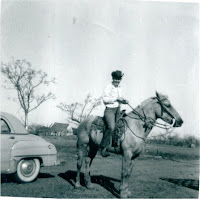


Pictured above: Three generations on the Farm at Potosi; Top -L to R: (Me) J. Bryan Wasson ; My Dad, J. B. (Jake) Wasson; Below: Our oldest Daughter Donna, Wasson
Key Words:
The Farm at Potosi
Potosi, Texas
Looking Back by J. Bryan Wasson
Wasson's Looking Back
Looking Back
J. Bryan Wasson
Life on the Farm
Farm Life
Texas
By J. Bryan Wasson
The advances of the 20th century sort of overtook and overwhelmed my dad, J. B. “Jake” Wasson. He was a lover of the land with his greatest desire to live on the land.
He grew up on a farm in the Noodle community of Jones County, Texas. He was a product of the great depression and I suspect it was the major factor in his leaving the farm and moving to Abilene in Taylor County. He thought it important for a man to own some land and livestock. He never gave up his desire to return to the farm.
I was born in a house on Portland Street in Abilene on January 22, 1933.. Throughout my childhood, we moved from one rent house or apartment to another. For a short period of time we lived in Eastland, Texas. In Eastland, my dad worked in a drug store owned by a family friend who was a member of the Vletas family. The Vletas family is well known in Abilene as a maker of fine candies.
We returned to Abilene in 1938 we lived for a short time in a rented house at the north edge of Abilene on what was then Pine street. I remember well the second residence we had upon return to Abilene. It was an apartment at 142 ½ Elm Street. It was located above the O.W. Jolly Saddle Shop where I became a friend of O.W. Jolly learned much about saddles, harness, etc. I had the same love of the land as my dad. There was a vacant lot next to the saddle shop where I rode imaginary horses and harnessed imaginary teams. With these imaginary teams, I plowed the imaginary fields of my imaginary farm.
Our next residence was a rent house on E.N. 18 th street directly across the street, with a large vacant lot between, from Abilene Christian Collage. It was while living there and in the 2nd grade that my dad purchased my first horse. Our landlord owned a dairy farm just east of the college campus. Part of that farm is now occupied by the expanded campus of what has become Abilene Christian University as well as houses and business property. Our landlord owned a horse named Tony that was kept on the farm. I spent much time on that farm. My dad and I often went horseback riding with me mounted on my horse and my dad mounted on Tony.
I believe it was 1945 when my parents purchased their first home at 1502 Oak Street. It was not the farm, but close to it. It was at the south edge of Abilene. Mesquite pasture was directly across the street, east from our house. I kept my horse in that pasture. South and east of that pasture was cultivated land used for wheat farming. This area is now occupied by South Treadaway Blvd. which is primarily an industrial area.
Behind the house facing South 15th street was a detached garage. My maternal grandfather built a small barn next to the alley behind our house and garage along with a pen for a milk cow and a chicken pen. A small portion of the barn was used for a chicken house. An area between the cow lot, chicken pen and the garage was fenced for a vegetable garden. There were numerous vacant lots around us which we used for grazing for our milk cow and a Holstein bull calf that I had as a 4H project.
Especially on the south side of Abilene, the oldest part of the town, it was not unusual to find a barn behind houses and many people still maintained a milk cow and chickens.
This near farm like life at the edge of town was short lived. The city closed in around us. My dad and I both longed for the farm. My mother did not share that desire. She just sort of went along with it.
I believe it was late 1947 or early 1948 that the dream came true for both my dad and me. A farm at Potosi was located, the owners of which wanted to move to town. A trade was made and we moved to Potosi. At that time Potosi was a rural community located eleven miles south of Abilene. Our place was directly behind the Potosi Methodist Church and joined the Hancock place to our north. Two churches, Methodist and Baptist remain as next door neighbors with what was the Hancock place directly behind the Baptist church. Lytle creek runs through the pasture. In those days, it flooded about once per year. There was running water much of the time and there was a water hole that rarely went dry.
Shortly after moving in at Potosi my dad started buying calves and later on some yearling steers. Grazing was plentiful in the pasture and fields that had been left fallow for a number of years.
While living at Potosi, I attended Abilene High School. My major high school interests were Vocational Agriculture (now called Agricultural Education) and FFA, Future Farmers of America. My FFA projects were beef steers, swine and poultry. I was also on the FFA poultry judging team. I also had a horse and became a pretty good pasture roper.
I enlisted in the U.S. Air Force in 1951. While I was in the Air Force, I frequently sent money home to purchase calves. During the time I was in the Air Force, My uncle, Homer Reeves, purchased a house in Potosi for my maternal grandparents. The back of the lot joined our property. My Grandfather J.A. Sterling put in a gate to make access between the two places easier. After I was released from active duty in the Air Force, my Dad and I became partners in some cattle.
I married Shirley Mazy in 1956. We lived in Abilene for a short while, however my dad gave us 5 acres of land and we moved to the farm at Potosi. We located a man in Priddy, Texas who had bought numerous buildings from the Government located at military Base that had been closed. From him we purchased what had been an old Orderly Room type building. We leveled the place where the house was to sit with a Fresno (designed to be horse drawn) pulled behind my dad’s 1937 Chevrolet. We dug holes for concrete footings upon which concrete blocks were placed for a foundation. The result was a pier and beam foundation built form concrete blocks. When the foundation was completed, the man from whom we had purchased the house moved it in and set it upon the foundation. Our house was located in close proximity to the home of our parents with less than 50 yards between. We paid this house off in seven years. Wow – I wish that could be done now!
Extensive remodeling was necessary to turn this military building into a house with two bed rooms, a living room, a bathroom and a kitchen. We lived in the house while construction was going on. Most of the carpenter work was done by my non carpenter dad. I was less of a carpenter than my dad, but helped as best I could. Shirley and my mother also did much of the work. None of us were carpenters, however we completed the job and it became our home. Our two daughters were born while we lived in that home. Over the years, we have lived in much better and nicer houses, but I have never been as happy as I was during the time we lived in that house.
Shirley and I did not know it at the time, but it turned out that we already had Potosi roots. After moving to Texas from Alabama, my mother as a child had lived in the Potosi area. Later she moved with her parents and siblings to Colony Hill, an area between Potosi and Abilene located on what is now FM1750.
In 1900, Shirley’s great-grandfather, John Revell built a cotton gin in the Lytle Cove area four or five miles southwest of present Potosi. It was located on what was the old Sumrall place. Later as a child, Shirley’s mother lived in the house on the Hancock place. That house was located very close to what is now the main entrance to Potosi Baptist Church.
Although five acres had been deeded to me by my dad, including part of the pasture and part of the cultivated land, there was never any distinction between my land and land owned by my parents. No fences separated my land and my parents land. The effect was one farm with two houses.
At some point my dad sold most of the land. The actual reason is unknown to me, but I believe it was due to his declining health. He kept the land on which the house, barn and outbuildings were located as well as part of the pasture. My five acres also remained.
To compensate for the land that had been sold, I leased the Hancock place which joined us to the north. I only had to open an existing gate to obtain additional grazing land for my horses.
In 1965 Shirley and I purchased a house in Abilene and moved to town. Was this a mistake? I often think it was. The house we purchased on Yorktown in Abilene was about a block away from a school. Had we remained at Potosi, it would have been necessary for the girls to ride a school bus to Wiley. When we moved to town, my dad purchased my 5 acres and the house back. My horses remained on the farm at Potosi. I continued to go to the farm at Potosi nearly every day to check on my horses. My love for the farm at Potosi never ceased. My Dad never ceased to have great love for this land.
My dad, a Taylor County Deputy Sheriff, died January 12, 1967 due to an injury that occurred in the line of duty as a result of being kicked in the abdominal area by a prisoner. In his dying moments he was thinking of the farm at Potosi. I was by his hospital bedside when he died. He looked at me and said, “I want you to promise me that you and Shirley will move back to the place at Potosi.” I agreed to his request and it was my intent and desire to keep that promise. Things changed; however, my mother remarried and sold the farm.
Abilene is swallowing up Potosi. Many of the former farms in the area are now residential subdivisions. I have a fear that has become a phobia that the land that was so dear to my dad and to me will be overrun with a housing development some day.
At the present time the land that my dad sold and part of the Hancock place is owned by my dear friend, Melvin Faircloth. The part of the Hancock place not owned by Melvin Faircloth is now owned by the Potosi Baptist Church. This gives me comfort because it is much like the land is back in the family.
During a visit with Melvin and Ginger Faircloth a few years ago, I dug up some prickly pear cactus from the pasture and transported it to Bowie where I set it out in our back yard where it joined an old cast iron hand pump and an old Georgia stock plow. The pump had been on a well located in our pasture that we used to pump water for the livestock when the creek was low. The plow had been retrieved from the farm many years ago. I guess these items represent a monument to the farm at Potosi.
Lawton Williams wrote one of my favorite songs entitled, "Mending Fences." That song describes my life in a happier time many years ago. I think it also describes the life of my dad, J.B. “Jake” Wasson. Part of the song is as follows:
“I grew up a country boy on our old family farm
Mending fences chasing cows out of daddy’s corn
My daddy lived a Christian life and his words sill apply
So I’ll keep mending fences until the day I die.”
The advances of the 20th century sort of overtook and overwhelmed my dad, J. B. “Jake” Wasson. He was a lover of the land with his greatest desire to live on the land.
He grew up on a farm in the Noodle community of Jones County, Texas. He was a product of the great depression and I suspect it was the major factor in his leaving the farm and moving to Abilene in Taylor County. He thought it important for a man to own some land and livestock. He never gave up his desire to return to the farm.
I was born in a house on Portland Street in Abilene on January 22, 1933.. Throughout my childhood, we moved from one rent house or apartment to another. For a short period of time we lived in Eastland, Texas. In Eastland, my dad worked in a drug store owned by a family friend who was a member of the Vletas family. The Vletas family is well known in Abilene as a maker of fine candies.
We returned to Abilene in 1938 we lived for a short time in a rented house at the north edge of Abilene on what was then Pine street. I remember well the second residence we had upon return to Abilene. It was an apartment at 142 ½ Elm Street. It was located above the O.W. Jolly Saddle Shop where I became a friend of O.W. Jolly learned much about saddles, harness, etc. I had the same love of the land as my dad. There was a vacant lot next to the saddle shop where I rode imaginary horses and harnessed imaginary teams. With these imaginary teams, I plowed the imaginary fields of my imaginary farm.
Our next residence was a rent house on E.N. 18 th street directly across the street, with a large vacant lot between, from Abilene Christian Collage. It was while living there and in the 2nd grade that my dad purchased my first horse. Our landlord owned a dairy farm just east of the college campus. Part of that farm is now occupied by the expanded campus of what has become Abilene Christian University as well as houses and business property. Our landlord owned a horse named Tony that was kept on the farm. I spent much time on that farm. My dad and I often went horseback riding with me mounted on my horse and my dad mounted on Tony.
I believe it was 1945 when my parents purchased their first home at 1502 Oak Street. It was not the farm, but close to it. It was at the south edge of Abilene. Mesquite pasture was directly across the street, east from our house. I kept my horse in that pasture. South and east of that pasture was cultivated land used for wheat farming. This area is now occupied by South Treadaway Blvd. which is primarily an industrial area.
Behind the house facing South 15th street was a detached garage. My maternal grandfather built a small barn next to the alley behind our house and garage along with a pen for a milk cow and a chicken pen. A small portion of the barn was used for a chicken house. An area between the cow lot, chicken pen and the garage was fenced for a vegetable garden. There were numerous vacant lots around us which we used for grazing for our milk cow and a Holstein bull calf that I had as a 4H project.
Especially on the south side of Abilene, the oldest part of the town, it was not unusual to find a barn behind houses and many people still maintained a milk cow and chickens.
This near farm like life at the edge of town was short lived. The city closed in around us. My dad and I both longed for the farm. My mother did not share that desire. She just sort of went along with it.
I believe it was late 1947 or early 1948 that the dream came true for both my dad and me. A farm at Potosi was located, the owners of which wanted to move to town. A trade was made and we moved to Potosi. At that time Potosi was a rural community located eleven miles south of Abilene. Our place was directly behind the Potosi Methodist Church and joined the Hancock place to our north. Two churches, Methodist and Baptist remain as next door neighbors with what was the Hancock place directly behind the Baptist church. Lytle creek runs through the pasture. In those days, it flooded about once per year. There was running water much of the time and there was a water hole that rarely went dry.
Shortly after moving in at Potosi my dad started buying calves and later on some yearling steers. Grazing was plentiful in the pasture and fields that had been left fallow for a number of years.
While living at Potosi, I attended Abilene High School. My major high school interests were Vocational Agriculture (now called Agricultural Education) and FFA, Future Farmers of America. My FFA projects were beef steers, swine and poultry. I was also on the FFA poultry judging team. I also had a horse and became a pretty good pasture roper.
I enlisted in the U.S. Air Force in 1951. While I was in the Air Force, I frequently sent money home to purchase calves. During the time I was in the Air Force, My uncle, Homer Reeves, purchased a house in Potosi for my maternal grandparents. The back of the lot joined our property. My Grandfather J.A. Sterling put in a gate to make access between the two places easier. After I was released from active duty in the Air Force, my Dad and I became partners in some cattle.
I married Shirley Mazy in 1956. We lived in Abilene for a short while, however my dad gave us 5 acres of land and we moved to the farm at Potosi. We located a man in Priddy, Texas who had bought numerous buildings from the Government located at military Base that had been closed. From him we purchased what had been an old Orderly Room type building. We leveled the place where the house was to sit with a Fresno (designed to be horse drawn) pulled behind my dad’s 1937 Chevrolet. We dug holes for concrete footings upon which concrete blocks were placed for a foundation. The result was a pier and beam foundation built form concrete blocks. When the foundation was completed, the man from whom we had purchased the house moved it in and set it upon the foundation. Our house was located in close proximity to the home of our parents with less than 50 yards between. We paid this house off in seven years. Wow – I wish that could be done now!
Extensive remodeling was necessary to turn this military building into a house with two bed rooms, a living room, a bathroom and a kitchen. We lived in the house while construction was going on. Most of the carpenter work was done by my non carpenter dad. I was less of a carpenter than my dad, but helped as best I could. Shirley and my mother also did much of the work. None of us were carpenters, however we completed the job and it became our home. Our two daughters were born while we lived in that home. Over the years, we have lived in much better and nicer houses, but I have never been as happy as I was during the time we lived in that house.
Shirley and I did not know it at the time, but it turned out that we already had Potosi roots. After moving to Texas from Alabama, my mother as a child had lived in the Potosi area. Later she moved with her parents and siblings to Colony Hill, an area between Potosi and Abilene located on what is now FM1750.
In 1900, Shirley’s great-grandfather, John Revell built a cotton gin in the Lytle Cove area four or five miles southwest of present Potosi. It was located on what was the old Sumrall place. Later as a child, Shirley’s mother lived in the house on the Hancock place. That house was located very close to what is now the main entrance to Potosi Baptist Church.
Although five acres had been deeded to me by my dad, including part of the pasture and part of the cultivated land, there was never any distinction between my land and land owned by my parents. No fences separated my land and my parents land. The effect was one farm with two houses.
At some point my dad sold most of the land. The actual reason is unknown to me, but I believe it was due to his declining health. He kept the land on which the house, barn and outbuildings were located as well as part of the pasture. My five acres also remained.
To compensate for the land that had been sold, I leased the Hancock place which joined us to the north. I only had to open an existing gate to obtain additional grazing land for my horses.
In 1965 Shirley and I purchased a house in Abilene and moved to town. Was this a mistake? I often think it was. The house we purchased on Yorktown in Abilene was about a block away from a school. Had we remained at Potosi, it would have been necessary for the girls to ride a school bus to Wiley. When we moved to town, my dad purchased my 5 acres and the house back. My horses remained on the farm at Potosi. I continued to go to the farm at Potosi nearly every day to check on my horses. My love for the farm at Potosi never ceased. My Dad never ceased to have great love for this land.
My dad, a Taylor County Deputy Sheriff, died January 12, 1967 due to an injury that occurred in the line of duty as a result of being kicked in the abdominal area by a prisoner. In his dying moments he was thinking of the farm at Potosi. I was by his hospital bedside when he died. He looked at me and said, “I want you to promise me that you and Shirley will move back to the place at Potosi.” I agreed to his request and it was my intent and desire to keep that promise. Things changed; however, my mother remarried and sold the farm.
Abilene is swallowing up Potosi. Many of the former farms in the area are now residential subdivisions. I have a fear that has become a phobia that the land that was so dear to my dad and to me will be overrun with a housing development some day.
At the present time the land that my dad sold and part of the Hancock place is owned by my dear friend, Melvin Faircloth. The part of the Hancock place not owned by Melvin Faircloth is now owned by the Potosi Baptist Church. This gives me comfort because it is much like the land is back in the family.
During a visit with Melvin and Ginger Faircloth a few years ago, I dug up some prickly pear cactus from the pasture and transported it to Bowie where I set it out in our back yard where it joined an old cast iron hand pump and an old Georgia stock plow. The pump had been on a well located in our pasture that we used to pump water for the livestock when the creek was low. The plow had been retrieved from the farm many years ago. I guess these items represent a monument to the farm at Potosi.
Lawton Williams wrote one of my favorite songs entitled, "Mending Fences." That song describes my life in a happier time many years ago. I think it also describes the life of my dad, J.B. “Jake” Wasson. Part of the song is as follows:
“I grew up a country boy on our old family farm
Mending fences chasing cows out of daddy’s corn
My daddy lived a Christian life and his words sill apply
So I’ll keep mending fences until the day I die.”
02-27-10, JBW
Note: Check out the website of the Texas Sheriffs’ Association at www.txsheriffs.org for information about the Association and the history of Sheriffs in Texas. While at the website, to learn about Sheriffs’ Office personnel killed in the line of duty, click on Lost Lawman Memorial. For information on individual inductees, check by county. For more information on individual inductees click the “More” button. For additional information about my dad, J.B. “Jake” Wasson, go to Taylor County. After his name click the “More” button. My dad is also listed on the Texas Peace Officer Memorial on the grounds of the State Capitol in Austin. You can also check for individual inductees aphetically. You can also see some great photography of Lost Lawman Memorial Services by Taylor County photographer, Tim Hutchinson. The month of May is Law Enforcement Memorial month.
Key Words:
The Farm at Potosi
Potosi, Texas
Looking Back by J. Bryan Wasson
Wasson's Looking Back
Looking Back
J. Bryan Wasson
Life on the Farm
Farm Life
Texas


.BMP)