Friday, January 29, 2010

My Hummingbird


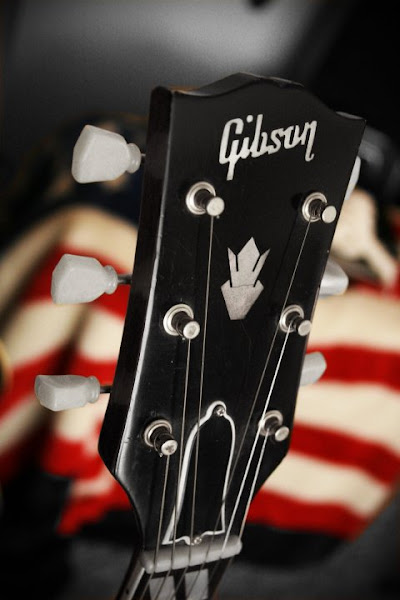
My Gibson Hummingbird guitar is my pride and joy. My wife, Shirley has often said that I take better care of it than I do her. In some respects, that may appear to be true. Back when I was going places to play my guitar, if I was taking the Hummingbird somewhere to play in the winter time, the car was warmed up prior to putting the guitar in the car. Likewise, in the summer time the car was started and the air conditioner turned on to cool the car off before the guitar was put in the car. When taken from one environment to another, the case was unlatched, but not opened for at least 15 minutes prior to taking the guitar out of the case. The Hummingbird is now semi retired and no longer leaves the house.

My first guitar was a Harmony arch top. I believe I was in the 3rd grade when my mother gave it to me for Christmas. My mother paid $15.00 for it - big bucks in those days. She purchased it 2nd hand from Harry Goltz Army Store in Abilene, TX. My mother put the guitar in lay-away and paid it out by the week - a big hardship in those days. It had belonged to a Soldier training at Camp Barkley who had shipped out to Europe during WWII.
After a few years of playing the Harmony, I really wanted a better guitar. I played guitars that belonged to friends. I fell in love with the sound of Gibsons and Martins. I have very small hands and in those days Martins had very wide necks - too big for my small hands. I decided that I wanted a Gibson. My first Gibson guitar was purchased for $55.00. I believe that was paid out in installments. I was extremely proud of my first Gibson Guitar. I guess I felt much the way about it that I now feel for my Hummingbird.
I enlisted in the U.S. Air Force in 1951. After Basic Training at Lackland Air Force Base and Air Police School at Camp Gordon, Georgia, I was stationed at Kirtland, Air Force Base, New Mexico. I missed having a guitar to play but was reluctant to bring my Gibson guitar from home to Kirtland AFB. My uncle , Bill Wasson worked at Turnage Furniture and Pawn Shop in Abilene. The Pawn shop stocked guitars. At the Pawn Shop, I purchased an identical, but slightly older used Gibson guitar for $35.00 to keep at Kirtland AFB.
In 1957 a Wasson family reunion was held at the American Legion in Abilene. I took both of my guitars to the reunion in the event that someone else who played and did not have a guitar with them would be at the reunion. After the reunion, I put my guitars in the trunk of our car to take them home. I forgot about the guitars and they remained in the trunk of the car for three or four weeks. This was a very bad thing. The heat from being closed up in the trunk of the car had melted the glue in the guitars. Although damaged, the guitars were still playable and continued to get much use for the next 9 years. There were many jam sessions with fellow Abilene Police Officer friends including Ken Hamil and John Hulen Roberts. I joined up with a friend, Bob Napier at Potosi. We called ourselves, "The Horsefly's" and entertained at various events using my two Gibson guitars.
In 1966 I learned that an acquaintance had traded his Hummingbird for a Gibson electric hollow body guitar. He told me the name of the music store that he had traded the Hummingbird to. Shirley and I went to the music store for a look at the Hummingbird. When I played this guitar, I fell in love with it. The price of the guitar was $450.00, more money than my mind could grasp for a guitar. Today's replacement cost is ten times that purchase price more or less a few bucks, dependant upon th source from whch the guitar is purchased. I no longer remember the amount the music store allowed for the two damaged Gibson guitars that were traded in on the Hummingbird. I became the proud owner of a $450.00 Gibson Hummingbird guitar. The acquaintance who had previously owned the Hummingbird said that it was originally owned by a member of Bob Wills, Texas Playboys, however I have no proof of that.

Tuesday, January 19, 2010

Mystry Riders


By J. Bryan Wasson

Sometimes an event is so far from the norm that it just sticks in our minds. This was the case with what I called the mystery riders.

My parents bought a house at 1502 Oak Street in Abilene, Texas back in about 1945. This house was on the far south edge of town at that time. The street only went for about five additional blocks and you were out of town. Everything south and east was farm land and Mesquite pasture. In fact there was a Mesquite pasture directly across the street (east) from our house. I had that pasture rented for my horse. A few blocks west of us, the city limits made a jog and went five or six additional blocks south. Again beyond that, everything was farm land and Mesquite pasture.

We had a large garden behind our house. There was a barn, cow lot and chicken pen. In addition to my horse, we had a milk cow and chickens. I dearly loved the long eared equine in those days, but my parents failed to see any reason I should own such a critter. Although we had the advantages of living in town, our location near the southern edge of Abilene was much like living out in the country. This was my kind of living. Little did we know that within the next couple of years we would see the city develop and grow all around us?

It was not uncommon in those days for city houses to have a barn behind them. Many people had milk cows, horses and chickens within the city limits. Oh, how things have changed.

About five miles north and west of us was a large area of Mesquite pasture that was unfenced on the north side. I estimate the area was a section (640 acres) or more. I was not mature enough in the ways of urban sprawl to realize at the time that when a fence was removed from pastures or farm land, it was the first sign of development to come.

To a teenage boy on horseback, this wide expanse of pasture land was unexplored territory. As far as I was concerned, no human being had ever set foot on this vast wilderness of Mesquite trees and Buffalo grass. I often explored this pasture alone. Sometimes my horseback riding friends would join me as we rode the rangelands of yesteryear.

One day I was sitting on our front porch. It was not unusual to see horseback riders and occasionally a wagon pulled by a team of horses or mules in town in those days, but what I saw was a bit unusual.

Headed south right in front of our house were four young horseback mounted men. I estimated them to be in their late teens or early twenties. Each man was leading a pack mule. One man in addition to the pack mule was leading two extra horses. Except in the Saturday afternoon movies, I had never seen such a sight.

I watched as they rode out of sight to the south. I pondered on the meaning of this event for a while, but soon it faded from my mind as more immediate things such as feeding my horse, the cow and the chickens consumed my thoughts.

A couple of weeks later, I went horseback riding with a couple of my friends. We decided to further explore the uncharted expanse of unfenced mesquite pasture. When we were rather deep into the thick Mesquite, we came upon a strange sight. We were looking at a camp. There was a large tent set up. It was about the size as what the U.S. Army calls a Squad tent. In fact that is most likely what it was. Rope had been strung between trees to form a rather large rope corral. Four mules and two horses were grazing in the corral. The grass was good and the Mesquite beans were plentiful.

We started yelling, “Hello the camp.” That is the way they did it in the western movies. It seemed that no one was home as we received no response to our calls. We got a little braver and rode closer to the tent. We dismounted and tied our horses to trees. It is hard to knock on the door of a tent. I was very reluctant to enter the tent, but with a little urging from my friends, we entered the tent.

There were four canvas Army type cots set up inside. Bed rolls were unrolled on the cots. A rope was strung between tent poles. A few shirts, four yellow slickers, and a couple of towels were hung on the rope. Over in one corner was a big pile of Mesquite beans that I am sure had been gathered as feed for the animals. I was rather uneasy. I did not want the folks who were living in this tent to come home and find us inside. I said, “Let’s get out of here.” I was the first one out of the tent.


From time to time, I would see a single rider, sometimes two riding in front of our house, headed north toward town. I sometimes saw this scene repeated headed south toward the camp site. I never saw all four of them together again.

Both alone and with my friends, I continued to explore this pasture. I did not, however, get so close to the camp of the mystery riders as before. I would creep up through the Mesquite brush and peek through just to see if the tent was still there.

These four mystery riders remained camped at that location for a year or more. They were gone by the time the bulldozers came to take further steps toward more urban sprawl.

The only thing that is sure about these mystery riders is that I don’t know where they came from or where they went. Were they on the run from the law? Were they criminals, jail escapees? Maybe they were folks just like me who did not like to see the city growing around them and were just trying to escape urban development.

My own personal suspicion is they were avoiding the military draft. World War II was over, but the military draft was still in effect. Most young men in those days who were not working or were not in school were serving in the Armed Forces. One thing is for sure. These mystery riders were on an adventure and I would bet they enjoyed every minute of it.
Note: This story has previously been published in The Brayer, official publication of The American Donkey and Mule Society.

Monday, January 4, 2010

Them Ain't My Calves


By J. Bryan Wasson


Bill Donald was our next door neighbor in the Potosi community. Potosi is located south of Abilene, Texas. His farming operation had been mostly grain crops. He also previously had a small cow/calf operation on his farm.

Back in the late 50s and early 60s the U.S. Department of Agriculture had a program called the Soil Bank. The purpose of this program was to reduce a surplus of farm products. Farmers were paid for not planting any crops or not running livestock on acreage placed in the program. Crops or livestock on land in this program was a violation of Federal law. Bill had placed his entire farm in this program.

The “Blue Bug Inn” was a domino hall located at the cross roads at the intersection of Potosi Road and what is now known as FM 1750. The “Blue Bug Inn” derived its name from the fact that it started life as a chicken house. Each day area farmers dropped by from time to time to play a game or two of dominos. Some retirees spent most of each day there playing dominos and swapping stories. My grandfather, Jess Sterling was among the retired men who spent most of each day at the domino hall. Due to the fact that Bill had placed his entire farm in the soil bank, he spent a large part of each day in the activities of the domino hall.

These elderly men enjoyed a good joke. They started messing with Bill’s mind by telling untrue tales of extremely expensive penalties required of non existent violators of prohibited use of land bank acreage. They convinced Bill that there was a Federal Agent lurking behind ever bush. They also convinced him that ever airplane that flew over was a Government aircraft, looking for illegal livestock or crops on land in this program.

My dad and I had previously been partners in some cattle, but at the time there was nothing in our pasture but horses. I was a member of the Abilene Police Department. At this time I was working the midnight shift and therefore sleeping in the day time. At about 2:00PM one day, I was rudely awakened by the ringing of the telephone. It was Bill Donald. He was spooked because he had observed some calves in his pasture. He excitedly told me “your calves are in my pasture” and that he wanted me to get them out immediately. I was angry and immediately hung up the telephone without saying anything.

By the time I went to work that night, I was still angry about having my sleep interrupted. I went about my duties, but remained out of sorts. At 2:00AM, I had a flash of genius. I telephoned Bill Donald. After about 10 rings of the phone, Bill sleepily answered the phone with, “hello.” I immediately harshly responded, “Bill. Them ain’t my calves!” I immediately hung up. I don’t think Bill ever spoke to me again.
01-04-10,JBW

Note: This story has previously appeared on the pages of The Brayer Magazine.

Sunday, January 3, 2010

Wild Horse Joe


By J. Bryan Wasson

His name was Joe Bagwell and he was a sure enough real cowboy. Everyone just called him, “Wild Horse Joe.”

I first met Wild Horse Joe in Abilene, Texas back in the early 50s. When I joined the Midland County sheriffs’ Office in the early 70s, Joe turned up in Midland, Texas. He was still breaking and training horses.

Joe could sure enough take the buck out of a horse and gentle a horse. Most of all Joe could put a rein on a horse. When Joe got through riding a horse it was much like a direct connection between the rider’s brain and the horse’s brain. Such slight pressure of the rein upon a horses neck was required that about all the rider had to do was think right or left and that is the direction the horse would turn. The horse would spin right or left with slight rein and leg pressure. The horse would change leads while doing circles or figure eights and stop on a dime from any speed. If Joe ever rode any mules, I was unaware of it, but if he had, I would have been extremely proud to have owned any mule trained by Wild Horse Joe.

Joe’s name never graced the pages of Western Horseman or any of the top equine publications. I guess you could say that Joe was the poor man’s horse trainer. He stayed busy and made his living by riding horses. Most of the top breeders, however, used better known horse trainers.

Joe was long on horse savvy, but he was a little short on “book learning”, sophistication and following rules. Joe did everything “Joe’s way.” I feel sure he never saw an A.Q.H.A. rule book. I also doubt that he ever heard the word, “dressage.” He did not know that he used many of the principles of dressage without having the slightest idea of the meaning of the word.

Along about 1957 or 58, I was serving as arena steward in a horse show. It was an open show, but we were using A.Q.H.A rules. Both registered horses and grade horses were entered in the show. Included in the events was a reining class. Joe showed up with a colt he had been riding and entered the reining class.

Everyone knew we were using A.Q.H.A rules. I guess everyone, but Joe. He had no knowledge of or interest in any kind of rules.

For the reining class, we used the pattern in the A.Q.H.A. rule book. Before judging of the reining horse class, one of the show officials put a horse through the official pattern as an example to help ensure that contestants followed the pattern.

Joe was about the third or fourth contestant in this class. He had ample opportunity to observe the pattern used with each of the contestants before him. Joe came out sitting tall and straight in the saddle with heels down and toes out. Joe had on bat wing chaps, and had his hat pulled down as if he were riding a bronc. He looked every bit the cowboy that he was.

When Joe came out, he put that colt through ever possible thing that the mechanical structure of a horse would allow. He put the 2 year old colt through spins in both directions, roll backs, sliding stops, figure eights and circles. He made that colt do everything that a horse could possibly do plus some things no one has ever thought of. It was a beautiful sight.

However, when the class was over, Joe had been disqualified and never knew why. I am sure that no one could have ever explained it to him. He did not in any way come close to the official pattern set for the reining class as specified in the A.Q.H.A. Rule book. The truth was that as far as the things that the colt Joe rode could do, the colt was the best reined horse there. The horse did every maneuver that was asked of him. Joe just did not understand and follow the rules

I would have loved to own any horse or mule that Wild Horse Joe had trained. In my mind, the good part of Joe’s methods was that he never considered the rein in each hand plow lining that is becoming so popular and considered by some to be “reining” today. Joe put a true neck rein on the horses he trained.

Note: This article has been previously published in the Brayer Magazine published by the American Donkey and Mule Society (ADMS)

May 16, 2005, JBW

Saturday, January 2, 2010

The Hay Ride


By J. Bryan Wasson


It was in the fall of 1949. I was a senior at Abilene (Texas) High School. I lived with my parents on a farm in the Potosi community, south of Abilene. The youth group of Potosi Baptist Church wanted to have a hay ride. Someone in the group said, "My father has a wagon, but nothing to pull it with, but a tractor or a pickup.
They wanted the wagon to be pulled by a real live team of equines, not a piece of machinery like a tractor or a pickup truck.


I volunteered to locate a team to pull the wagon. That proved to be much easier said than done. Getting the team together over the next three or four weeks, however, proved to be more fun than the actual hay ride.


There were four or five sets of harness hanging in our barn. There were collars, hames, traces, back bands, belly bands, breeching, everything that was needed. The problem was that the harness was old, unused for many years, dry, brittle and could have soaked up gallons of neets foot oil. The major problem, however, was that there was no team that this harness could be used on.


I had a good saddle horse, a sorrel mare that I called Lady. I knew that Lady would not pull a wagon, because I had already hitched her up to a Georgia stock plow, and that proved to be a disaster. She had run away with the plow, tearing down fences, chicken houses, and mesquite brush. I thought that I would never catch the mare. It was a miracle that she was not injured.

After a week or so, I located a man in the area who had a big brown gelding that he used as a saddle horse. He told me that the horse would also work, single or double. I now had half of a team to pull the wagon.

The man told me I could keep the horse as long as I wanted to so I took the horse home. I was feeding the horse so I decided to ride him often during the time I had him in my possession.


The second half of the team was more difficult to locate. One friend, a few miles up the road had a mule grazing in his pasture. The mule had been retired for many years. This mule was the only draft animal he had left after he switched from horse power (mule power in this case) to tractor power on his farm. He did not want to take his old mule out of retirement to pull a hay ride wagon loaded with a bunch of loud high school kids. His feelings about his old mule were understandable.

Harry Holt was an area farmer and rancher who was well known for his farm and ranch radio and TV shows. Harry Holt continues to do a farm and ranch radio and TV shows in Abilene. Harry Holt had a farm between Potosi and Abilene. I had often seen a small brown Jack grazing in the pasture at this farm; I drove over there and talked to the man who ran the farm for Harry Holt. The little Jack did not weigh over 600 pounds, but the farm manager said that he could be ridden and worked well in harness, single or double. I had the other half of my team. A strange looking team it would be, however, made up of a big brown horse and a little brown donkey. Hey, it was a matched team that is, if color is the only matter to consider in creating a matched team.


I hauled the jack home in a trailer and put him in the pasture with his team mate and my mare, Lady. In the back of my mind I thought it would be nice if this visit from the jack resulted in a mule foal. She was not, however, in this cool part of the year, in season. There would be no mule foal.


It was difficult to alter a set of harness to fit the little brown jack. A lot of padding was required in the collar. I spent a few days working on the harness and a few more days of "dry runs" with this strange looking team pulling the wagon.


One day I decided to ride the jack. I rode sitting on his hips, in the manner in which donkeys are ridden in many foreign countries today. I rode a few miles and stopped to visit with a friend, Joe Bynum for a while, then continued my ride home. The jack exploded. From my rear seat position, I don’t think I ever went higher in the air or hit the ground harder. Present day bull riders refer to this type of buck off as being bucked off from the "back door" or "a back door dismount."


The night of the long planned hayride arrived at last. The weather changed from cool to cold and then to very cold. It was what we call a "Texas blue norther.’’ Someone in the Panhandle of Texas had "left the north gate open."

I hitched up the team, but then had some last minute problems with the old, worn out and over sized harness for the little jack. The cold north wind was not helping the situation any.


The best that I can remember is that I rode in the pickup truck that pulled the hay ride wagon that night.

01-25-02, JBW